
Acadians at large
A New Year's slant-told tale

Culture is ultimately lost when we stop telling the stories of who we are, where we have been, how we arrived here, what we once knew, what we wish we knew; when we stop our retelling of the past, our imagining of our future, and the long, long task of inventing an identity every single second of our lives.
Deborah A. Miranda, author of Bad Indians: A Tribal Memoir
In 2024, when I started posting Acadiann, I had one question: “What’s an Acadian?”
Since then, I’ve been digging into names, bits and pieces of scattered histories, novels, family tales, and stories posted on WikiTree by volunteers who sit in my personal Pantheon of goddesses and gods.
Now comes the 2026 question: what happened after the Expulsion?
Some, in made-for-novel-adventures, returned home to reunite with family.
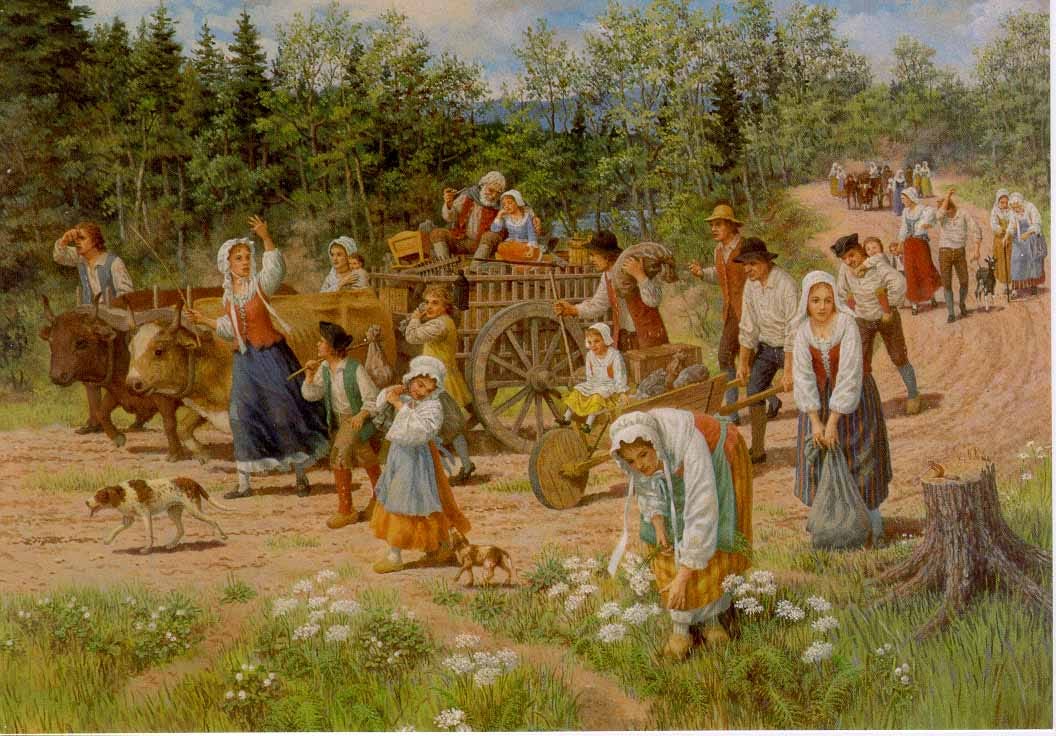
Le retour by Claude Picard, accessed 1.1.26 at https://www.geocities.ws/pitre_family/Gen4.html
Some were deported again. My own 5x great-grandmother Marie Vigneau was uprooted 9 times before she settled in the Acadian refugee haven of Nicolet, Québec.
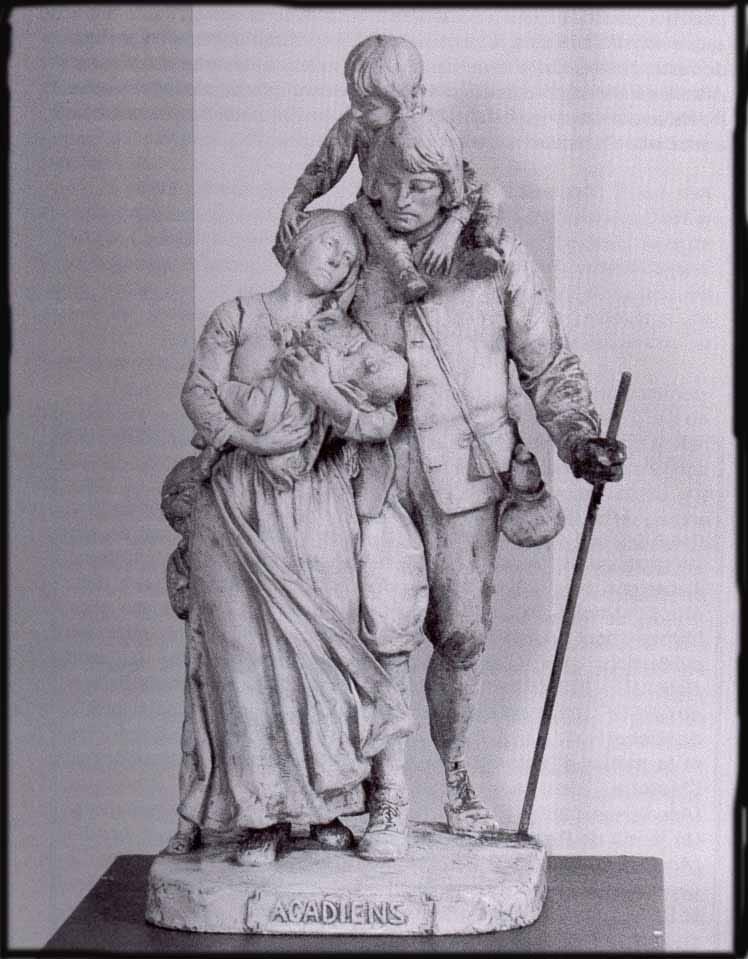
Les Acadiens, Sculpture by Philippe Hébert, 1906. Collection from the Seminary of Nicolet accessed 1.1.26 at https://www.geocities.ws/pitre_family/Nicolet.html
For those who didn’t return, where did they go? Did they remember their history or, as happened in my family, did they not talk about it until the descendants didn’t know about Acadia?
As “missing persons” emerge from the mists of history, I seek details about the migrations and daily lives of the so many ordinary people that were the ancestors. In the words of Paul Harvey, I seek “the rest of the story.”
When a synchronicity of ancestral names, words, and images collide in the now, I’m inclined to follow the connections. Sometimes there is a marvelous revelation — as happened recently.
Observing a mistaken lineage, I begrudgingly detached a second great-grandmother’s parents from their ancestors in a database I’d built in the analogue world decades ago from Drouins, Tanguays and parish registers. Hours of on-site research and data entry evaporated.
But seeking the correct lines in the digital world (WikiTree, Génealogie Québec) led to an Acadian line I didn’t know was mine: the Savoie-Pellerins. The print I bought a year ago is now more than cultural heritage; this homestead is personal history.
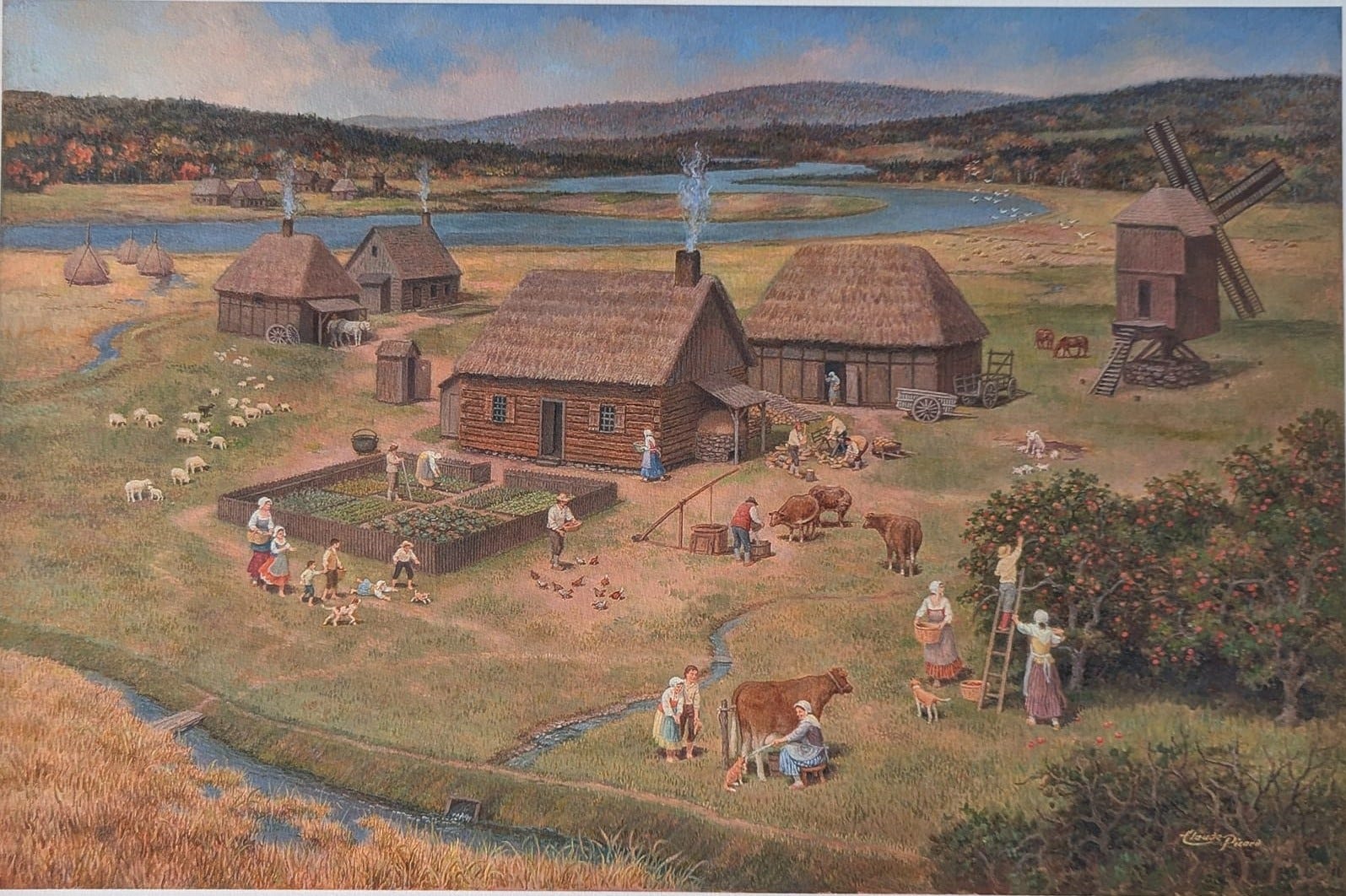
Temps heureux chez les Savoie et leurs voisins acadiens Belleisle vers 1690 by Claude Picard English: Happy times with the Savoies and their Acadian neighbors in Belleisle circa 1690
Which all is backstory to how I’ve wandered about to learn of Noël Carrière from New Orleans. Who is not a cousin as I know it now, though I have learned “never say never” about anyone who shows up in a post-Expulsion Acadian hotspot.
As often happens when one sets about either a genealogy search or research into the lives and times of a particular ancestor, pretty-shiny things appear in historical documents and even daily events.
This tale was triggered by a daily event.
Noël Carrière showed up in a Facebook group. He was the leader of the New Orleans black militia and an American Revolutionary War hero.
I don’t have Black ancestors that I know of, but I couldn’t help myself asking if he was a cousin. Carrière is a version of Carrier, who are in my ancestral lines. And, when it comes to South Louisiana and its French and Acadian lineages, as cousin Savanna King says, you mostly wonder who you aren’t related to.
My Carrier-Samson lines show up in Québec, Port Toulouse, Louisbourg, Caraquet, and Rimouski. Canadian Francois Carrier and Acadian Anne Samson probably married in 1777 in Louisbourg, which is curious all on its own since at that point the fortress was a war ruin.
Another cousin, Nicole Gallant Nunes, once suggested that stories about Acadian life on Cape Breton (where Louisbourg sits) could benefit from some attention. She named the Poujet(Lapierre), Moyse, and Vincent clans, who are the ancestors of my Samsons and Carriers, as names to research.
Also sparkling in the pretty-shiny pile was the memory of Savanna’s recent Substack post “What makes someone an Acadian?” In it, she urged us to cast a wider net when we look for ancestors, to consider that a hole or absence in finding records is because we’re not thinking broadly enough about how people traveled back in the day, or how families dispersed and reconnected. Several centuries ago, for example, people traveled river roads and seas, which made for different access routes than the land roads we default to today.
I couldn’t find African Noël on WikiTree. The upshot of that foray into ancestry is that the US Black Heritage Project created a stub for him. Savanna went into her rabbit warren and found wills, birth, marriage, and death certificates, and I selected significant parts of The Strange History of the American Quadroon by Emily Clark (January 1, 2013, University of North Carolina Press) to add to research notes.
That would have been the end of it except that there was another Noël Carrière on WikiTree listed as born about 14 years before Noël the war hero. Could they be the same person? Half-siblings? Cousins?
French Noël is listed as my 2nd cousin, 9 times removed, which still counts as a cousin in the world of French cousinage. This Noël’s parents were married in Louisiana, probably New Orleans.
Brain hijacked and the game afoot. Though it would likely lead to an uncomfortable truth about ancestral roles in enslavement.
As it turns out, French Noël (b. 1732) is listed as the white son of Joseph Carrière and Marguerite Trépagnier. Marguerite owned (cringe) African Noël (b. 1746), who was the son of Joseph Leveillé, a laborer for the Ursuline nuns, and Marie-Thérèse Carrière, a bondservant in the Carrière-Trépagnier household (Clark’s Chapter 5).
Well, if they weren’t related by blood, they were by circumstance.
African Noël was a cooper and tanner, and, from 1764-1771 lived as a libre en fait (free person) even if he wasn’t officially manumitted. According to Professor Clark’s book he even managed as an enslaved teenager to own two slaves, which, she wrote, was both illegal and unheard of.
French Noël’s dad Joseph Carriere (b. 1682, Montreal) had good penmanship. You can see it in his signature when he witnessed baptisms in Montreal. Maybe not the most interesting fact, but it probably means he was literate.
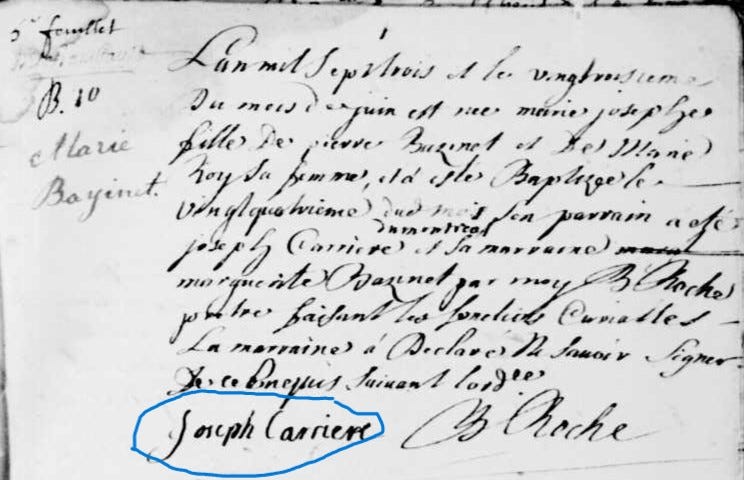
Baptismal record of a Boyer child in 1706 Montreal, Notre-Dame-de-Montreal
Joseph’s first cousin Pierre (b. 1662) was a marine whose wife Madeleine (b. 1673) was captured by the Iroquois during the Lachine massacre (Aug. 5, 1689), and released in 1700. I can imagine Joseph might have had a number of reasons for wanting to leave Montreal for New Orleans.
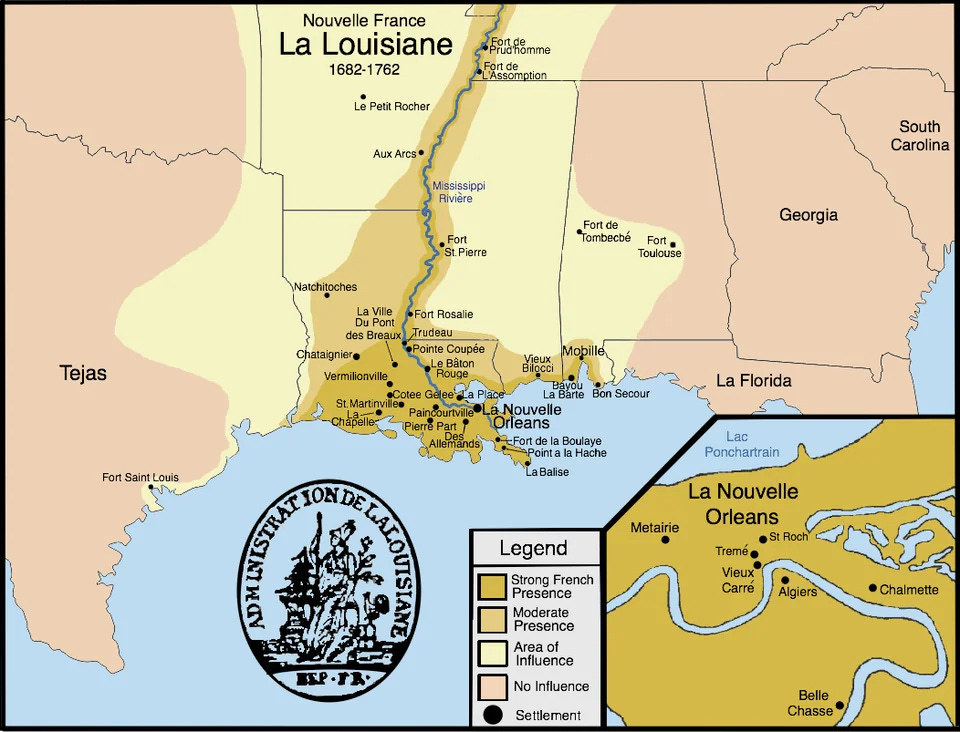
French Louisiana https://www.reddit.com/media?url=https%3A%2F%2Fexternal-preview.redd.it%2FvvjS7Ly9ebENGO0IX8wSoXUawRwm2Wd8yniQ8Q8Rtvw.png%3Fwidth%3D960%26crop%3Dsmart%26auto%3Dwebp%26s%3D10e2da865e65ee2822363ef353dfa8c8487f91db
French Noël’s mother Marguerite was born (1708) in Mobile, Louisiana, the granddaughter of a fille-du-roi.
Lisa Elvin-Staltari’s YouTube episode tells Marguerite’s grandmother’s story, and the tale of how Marguerite’s mother came to Mobile. I can imagine that their leaving Montreal in 1700 had something to do with the Lachine massacre, too.
I still don’t know whether there is a connection between African Noël or French Noël and my Acadian Carrier-Samson ancestors.
There is, however, a slant, though uncomfortable, connection to Canadian cousins in the Carrière-Trépagnier line of early New Orleans’s European founders.
Resources
Louisianan ancestors who survived the Lachine Massacre
Classroom activity and graphic novel of LeSeur family traveling from Canada to Old Mobile
Old Mobile: Archaeological treasures in Louisiana’s first capital by Gregory A. Waselkov
Excerpt: The Mobilians and the rest of the petites nations, numerous small towns of diverse Native peoples living near the coast, hoped the French presence would finally put an end to raids by Muskogee (Creek) warriors from the north who had been selling captives from other Indigenous groups in the slave markets of English Charleston, South Carolina.
Between 1702 and 1711, a visitor strolling the streets of Mobile would have seen about as many Native Americans, free and enslaved, as colonists in the French colonial capital.
Free persons of Color in Colonial Louisiana
French Colonial Archaeology at Old Mobile: An Introduction
Another family leaves Montreal for Lousiana -- Joseph Chauvin and Louis Chauvin, who may be relatives of French Noël.
Writing New Orleans into the American Revolution by Emily Clark
Future research to do:
(1) Dig deeper into French Noël’s lineage through original documents. Baptismal records at St. Louis in New Orleans show siblings Antoine (1744), Francois (1733), Francoise (1748), Henry (1730) and Marguerite (1729). But no Noël, born in 1732 (WikiTree).
(2) Dig deeper into the Sacramental records of St. Louis in New Orleans.
In a marriage record, a brother named André is listed.
In a baptismal record, Joseph and Marguerite are listed as the grandparents of Genevieve Therese, daughter of Marie-Therese and her husband Louis Antoine Decallogne.
So…now there is an African and a French Marie-Thérèse as well?
What was going on in this family?
If you are working with Savanna on this, answers will eventually come, or you will find more rabbit holes to go down, keep the stories coming.
Your stories are always captivating and intriguing.