
Acadian diary #2
Spaces of power

The launch of this season’s Acadian Archives lecture series is the reason I’ve lost sleep the last few nights. I keep waking with mental images of “this” or “that,” which fit the life of little Marie Vigneau, 10 or 11 years old in 1750 Beaubassin, Acadie.
The topic on Feb 12 was “The Slow Rush of Colonization: Spaces of Power in the Maritime Peninsula” with guest historian Thomas Peace.
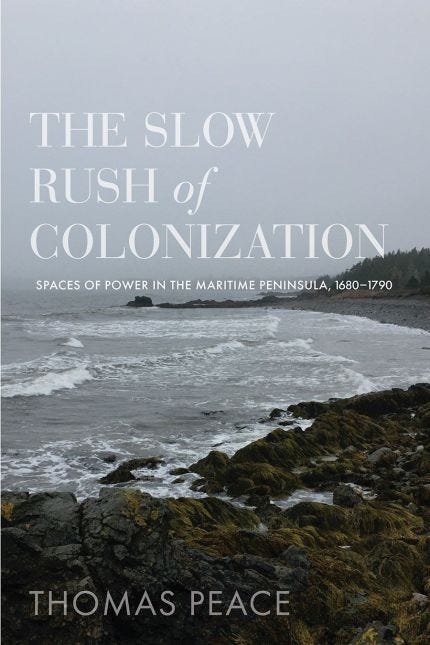
University of Chicago Press image
His publisher’s blurb states Drawing on the concept of spaces of power, historian Thomas Peace demonstrates that despite imperial changes of power and settler colonial incursions on their Lands, local Mi’kmaw, Wabanaki, Peskotomuhkati, Wolastoqiyik, and Wendat nations continued to experience the contested Peninsula as a cohesive whole, rather than one defined by subsequent colonial borders.
Peace called Thursday’s session an experimental talk, one he hoped would have a lively Q&A. Because the Acadian story is also one shaped by spaces of power, though one that could use more scholarship.
Personally plagued throughout the talk by wondering what an historian means when s/he says spaces of power, I defaulted to just listen. Which continued to plague my sleeping brain until the wee hours of the morning when I surrendered and sought out my new assistant, AI DeepSeek.
Acadiann: Please explain “spaces of power” in simple, not academic, English.
DeepSeek: “Spaces of power” is a fancy term for the idea that where people are can change how powerful they feel or act.
Think of it like this: A place isn’t just a location; it can give you more or less power depending on who you are.
Acadiann: Is this also what an historian means by "spaces of power"?
DeepSeek: A “space of power” is a place that shapes, shows, or controls who has the upper hand. An historian just adds the “who, how, and why” over time.
(Aside: some in the U.S. are adamantly against using DeepSeek because it’s a Chinese company that may spy on us. Just tickles my fancy to consider the possibility of informing spies about Acadian history.)
Well, then, I’m no historian, but those are precisely the questions that plague me about a child living in the 1750s Beaubassin conflict zone. Her space-of-power, like most children through time and place, was powerlessness. (Exceptions for maybe Louis XIV and other royals who ascended thrones as children.)
I thought that was enough to put the plague of thinking to bed.
But the dreaming mind wandering around a sleeping brain is a mysterious thing.
Another night followed of images of Marie coming of age while adult men defended their indigenous land, allying with either French or British soldiers and rangers, her Acadian adult caregivers maybe trying to thread the neutral needle, or picking a side. Her mother and aunties and cousins trying to keep up with the housework and raise the babies.
What would my other assistant, AI ChatGPT, have to say about that? Because ChatGPT, unlike DeepSeek, remembers that I’m interested in Marie in mid-18th century Nova Scotia.
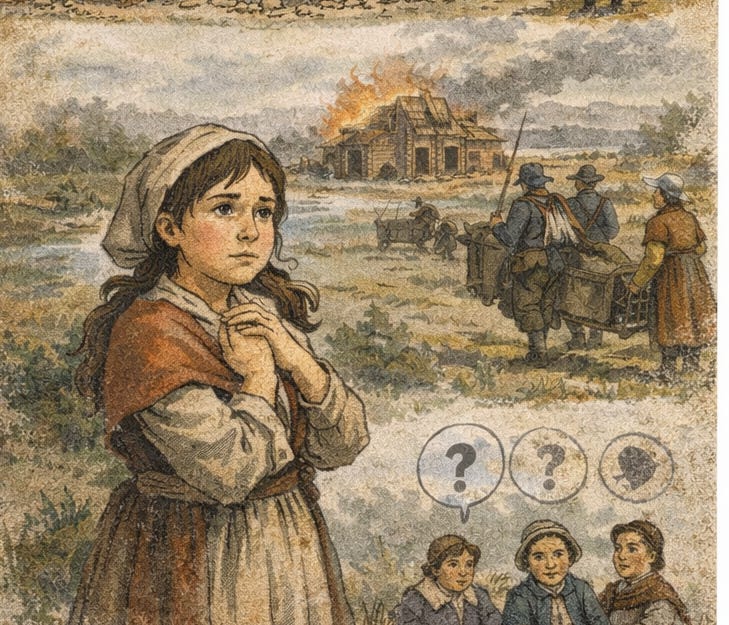
ChatGPT-generated image from Acadiann prompts 2.14.26
ChatGPT concluded that Peace’s book is particularly relevant to understanding Marie’s life. That the politics, geography, colonizing through infrastructure, everyday life, violence, and negotiation were spaces-of-power.
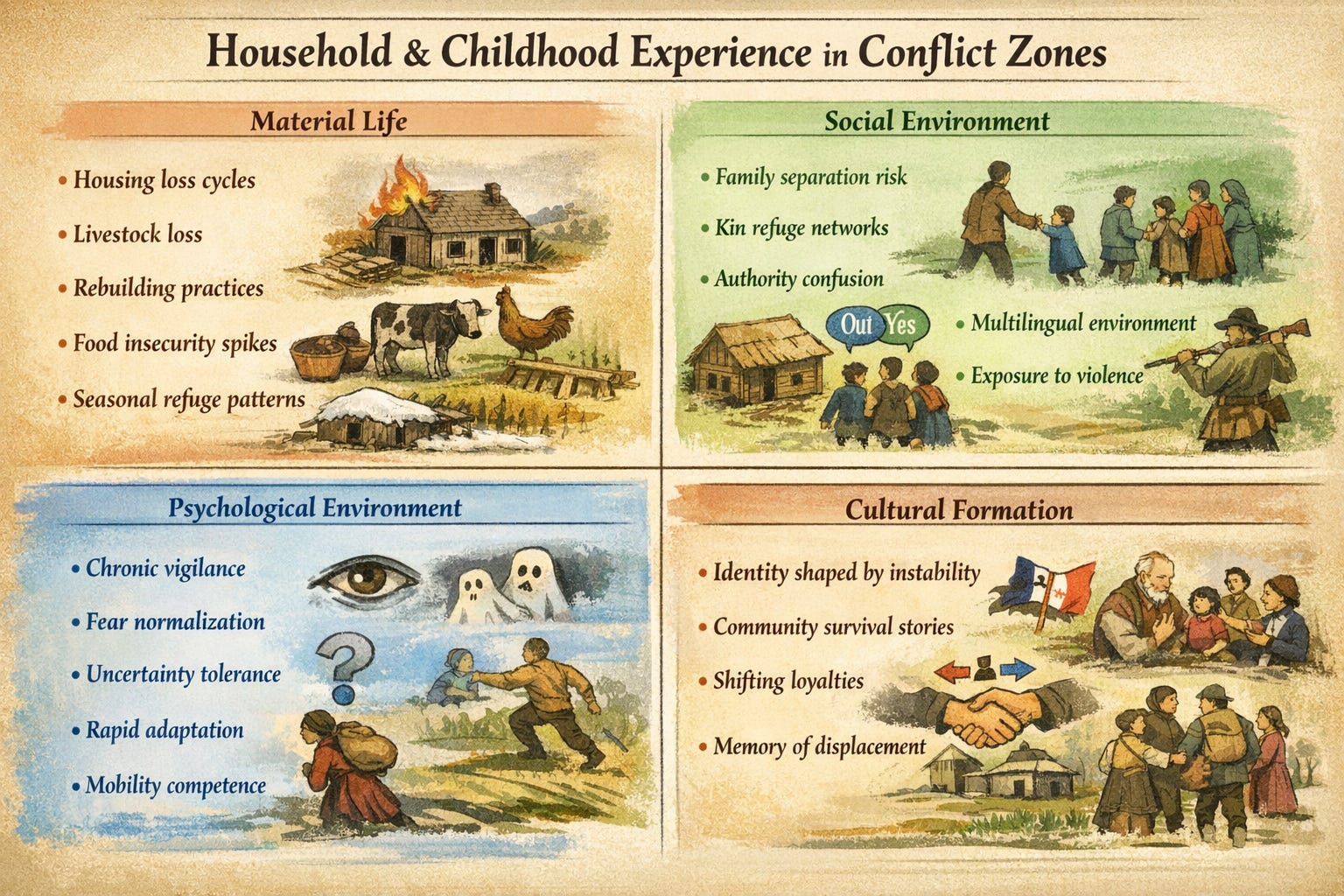
ChatGPT-generated image from Acadiann prompts 2.14.26
ChatGPT: It (Peace’s book) supports your idea of reading events as part of a conflict-zone childhood environment rather than isolated incidents.
Fist-pumps. Thank you, Professor Peace! My emerging novel is rooted in evolving historian-think.
Another image, memory surfaced from my childhood, one that seems relevant to the perception of spaces-of-power to a child.
Sometime between age 8 and 10, I realized that, in my Little Canada, I lived within two different geographies. I can feel the fall air and hear the rustling leaves along the broad, tar driveway that passed between the convent and the rectory as I walked home from school.
One set of bounds was defined by the Catholic Church. It outlined parish and diocesan boundaries. The parish radiated out from the hub of the local church, until it met the bounds of the next local church. The diocesan bound was more amorphous.
The other was defined by Massachusetts’s meets and bounds. The town’s geography radiated out from the hub of Town Hall.
At least to my child-mind.
Neither me nor Marie at that age understood the concept of spaces-of-power, but we could feel them, could react to them, could absorb them.
If I could notice different boundaries layered over the same physical space, why couldn’t Marie think about the sway and say of the various military and non-military adults in her marshland world? Why wouldn’t she feel unanchored as much by the burning of Notre-Dame-de-l'Assomption church as by her home? Both are spaces of power.
Her meets and bounds shifted abruptly and violently in 1750. Somehow that shaped the person she would grow into.
Resources
Sample chapter from Peace's book
The Forts of Chignecto, 1930, John Clarence Webster,
Addition 2.16.2026
Island of Pheasants where no pheasant ever lived
This is a fun take on a quirky place across the pond that changes its “space of power” every six months — between France and Spain. By Jasmine Grace St-Pierre.
Entertaining as always.